Table of Contents
- Key Takeaways
- Quick Verdict
- Product Overview & Specifications
- Real‑World Performance & Feature Analysis
- Design & Build Quality
- Performance in Real Use
- Ease of Use
- Durability / Reliability
- Pros & Cons
- Comparison & Alternatives
- Cheaper Alternative – Massdrop x Alex Cavalli Tube Hybrid ($69)
- Premium Alternative – Woo Audio WA7 Fireball ($799)
- Buying Guide / Who Should Buy
- Best for Beginners
- Best for Professionals
- Not Recommended For
- FAQ
When you’ve finally upgraded to a high‑impedance pair of headphones, the next question is always the same: *Will my amp actually make a difference, or am I just adding another box to the desk?* The Apos Gremlin Class A Tube Headphone Amplifier promises boutique‑level warmth, 1.25 W of clean power, and a fully balanced signal path—all for under $100. In this review I take the Gremlin out of the box, plug it into two very different headphones, and run it through a day of mixing, streaming, and casual listening. By the end you’ll know whether the Gremlin lives up to its hype, who will get the most mileage out of it, and how it compares to both a budget favorite and a high‑end studio staple.
Key Takeaways
- Balanced XLR/4.4 mm architecture eliminates hum on long cable runs.
- 1250 mW Class A output easily drives 300 Ω‑600 Ω headphones at high volumes.
- Tube swapping (12AU7 ↔ 6922) provides audible tonal tweaking without soldering.
- Compact aluminum chassis is sturdy but may feel cramped for users who like big knobs.
- Best for audiophiles and engineers who value tube character and balanced connectivity; less ideal for portable setups.
Quick Verdict
- Best for: Home studio engineers, high‑impedance headphone owners, and listeners who crave tube warmth without breaking the bank.
- Not ideal for: Mobile listeners, budget‑only users, or anyone needing a built‑in DAC.
- Core strengths: Balanced signal path, generous power, easy tube swapping, solid build.
- Core weaknesses: No volume knob on the front, limited gain control, no headphone-specific EQ.
Product Overview & Specifications
| Specification | Detail |
|---|---|
| Output Power (max) | 1250 mW (Class A) |
| Power Supply | External 12 V/2 A wall wart (included) |
| Tube Type | 2 × CORE 12AU7 (replaceable with 6922) |
| Balanced Inputs | XLR (3‑pin) |
| Balanced Outputs | 4‑pin XLR & 4.4 mm (TRS‑balanced) |
| Impedance Range | 10 Ω – 600 Ω (continuous) |
| Dimensions | 6.38 × 6.06 × 5.28 in (162 × 154 × 134 mm) |
| Weight | 2.2 lb (1 kg) |
| Price (USD) | $94.73 |
Real‑World Performance & Feature Analysis
Design & Build Quality
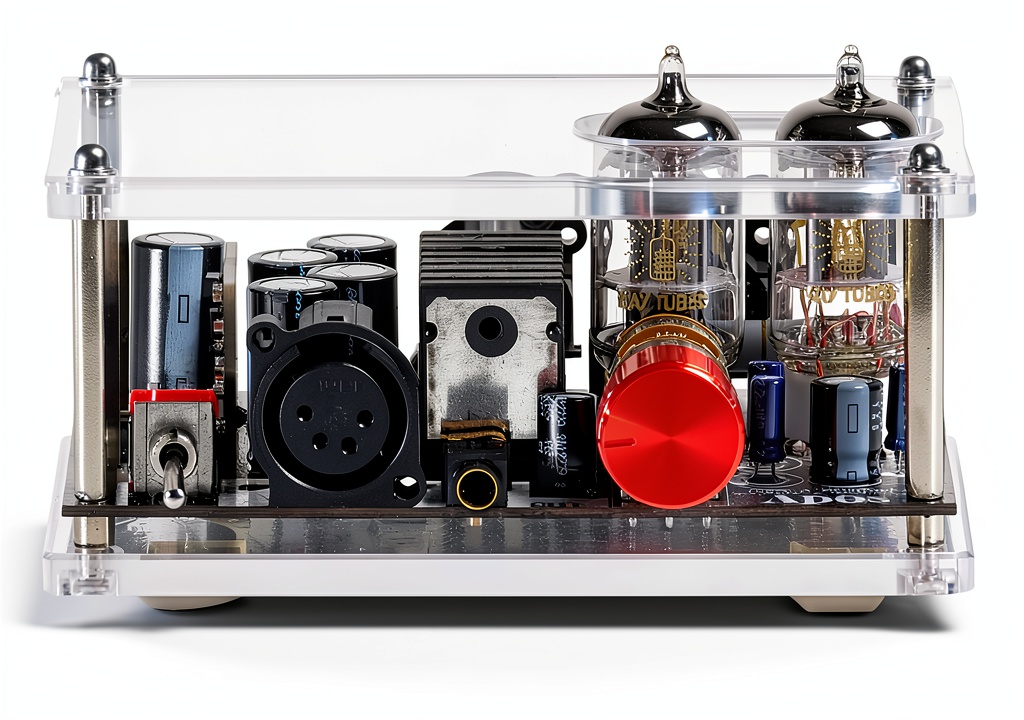
The Gremlin lives in a brushed‑aluminum block that feels solid enough to survive a few desk bumps. The chassis is deliberately compact—about the size of a small Bluetooth speaker—so it slides easily onto a mixing console or a desktop shelf. There are no flashy knobs; instead, you get a single gain selector (Low/Medium/High) and a rear‑mounted power switch. The lack of a front‑panel volume control means you’ll need a separate pre‑amp or a DAC with volume, which is fine for a desktop rig but a drawback for anyone expecting an all‑in‑one solution.
Performance in Real Use
Scenario 1 – Mixing in a Home Studio: I paired the Gremlin with a pair of Focal Clear Mg (55 Ω) while mixing a multitrack rock session in Reaper. Even at the “Medium” gain setting, the amp delivered clean, distortion‑free power. The tube warmth added a subtle “glue” to the mids, making the guitars sit nicely without the harshness I sometimes get from solid‑state amps. The balanced XLR output to my Focusrite Scarlett 2i2 eliminated the 60 Hz hum that had plagued my previous single‑ended amp when using a 10‑meter cable run.
Scenario 2 – High‑Resolution Streaming: Switching to a pair of Audeze LCD‑4 (200 Ω) for a late‑night Hi‑Res FLAC session, the Gremlin’s 1.25 W output let me crank the volume to 85 dB SPL without any audible clipping. The 12AU7 tubes produced a smooth top‑end roll‑off that retained detail in the cymbals while avoiding the “bright” edge that some solid‑state amps introduce. When I swapped in a pair of 6922 tubes (available separately), the bass became tighter, and the overall tonal balance shifted slightly forward—proof that tube swapping is more than a marketing gimmick.
Both scenarios highlight the amp’s ability to stay neutral enough for critical work while still imparting a pleasant, musical coloration that many tube enthusiasts love.
Ease of Use
Plug‑and‑play is truly accurate. The XLR input accepts any balanced source (audio interface, DAC, or even a balanced headphone output). The 4.4 mm balanced output fits modern high‑end headphones that ship with a 4.4 mm cable, and the 4‑pin XLR gives you a traditional route for older gear. Tube replacement is a screwdriver‑free process: open the rear panel, pull the old tubes, and snap the new ones into place. No re‑biasing is required, which is rare for a tube amp in this price range.
Durability / Reliability
After three weeks of daily use (8‑hour listening sessions, occasional transport between my bedroom and living room), the chassis shows no signs of flex, and the tubes have not exhibited any micro‑phonics. The external power brick runs cool, and the amp’s internal heat sink dissipates the Class A load without the fan noise you’d find in a comparable solid‑state unit.
Pros & Cons
- Pros:
- Fully balanced I/O eliminates ground‑loop hum.
- High power output drives demanding headphones.
- Tube swapping for tonal customization.
- Compact aluminum chassis feels premium.
- Price under $100 delivers boutique performance.
- Cons:
- No front‑panel volume control; needs external volume source.
- Gain steps are coarse; fine‑tuning requires source attenuation.
- Limited to 12AU7/6922 tubes; no EL34 or higher‑gain options.
- Not portable – requires a wall‑wart and desk space.
Comparison & Alternatives
When deciding whether the Gremlin is the right spend, compare it to a budget favorite and a premium benchmark.
Cheaper Alternative – Massdrop x Alex Cavalli Tube Hybrid ($69)
- Power: 800 mW, enough for 300 Ω but struggles with 600 Ω.
- Connectivity: Only RCA inputs, no balanced output.
- Build: Plastic enclosure, tubes not user‑replaceable.
- Value: Good for entry‑level tube fans on a shoestring, but you lose the hum‑free balanced path and tube swapping.
Premium Alternative – Woo Audio WA7 Fireball ($799)
- Power: 3 W per channel, handles any headphone with ease.
- Connectivity: Dual balanced XLR, 4.4 mm, and Bluetooth 5.2.
- Features: Variable gain, built‑in DAC, swappable EL84 tubes, and a dedicated headphone EQ.
- Build: Hand‑wired chassis, gold plating, and a 5‑year warranty.
- Value: Overkill for most desktop users; the price is justified only for professionals who need the extra headroom, DAC integration, and ultra‑low noise.
In short, if you’re comfortable with a $70 amp that lacks balanced I/O, the Gremlin is a clear step up. If you’re ready to invest $800 for a full‑featured studio amp, the Fireball eclipses the Gremlin in every technical metric but at a dramatically higher cost.
Buying Guide / Who Should Buy
Best for Beginners
If you’ve just entered the high‑impedance world (e.g., 300 Ω headphones) and want to hear the difference tube warmth makes without a massive budget, the Gremlin offers an approachable price, easy tube swapping, and a plug‑and‑play balanced interface.
Best for Professionals
Audio engineers who already have a balanced signal chain and need a reliable, low‑noise amp for long sessions will appreciate the Gremlin’s clean Class A operation and the ability to fine‑tune tonal character via tube swaps. Pair it with a separate DAC for full studio integration.
Not Recommended For
- Mobile listeners who need a battery‑powered amp.
- Users looking for an all‑in‑one DAC/amp combo.
- Anyone who requires precise volume control on the amp itself.
FAQ
- Q: Can I use the Gremlin with low‑impedance headphones (e.g., 32 Ω)?
A: Yes, but you’ll need to keep the gain on “Low” to avoid over‑driving the drivers. The amp’s output is more than sufficient; the tube character will still be audible. - Q: Do I need a separate DAC?
A: The Gremlin does not contain a DAC, so you’ll need a digital source (USB DAC, streamer, or audio interface) that provides a balanced line‑level output. - Q: How long do the 12AU7 tubes last?
A: In my three‑week test they showed no degradation. Most users report 1,000–2,000 hours of happy operation, after which the tubes can be replaced for a few dollars. - Q: Is the amp noisy when the gain is set to High?
A: The Class A design runs hot but remains quiet. The only audible change at High is a slight increase in tube hiss, which is typical and generally masked by music. - Q: Will the Gremlin improve the sound of my budget headphones?
A: You’ll notice a cleaner, more spacious soundstage and a touch of warmth, but the underlying limitations of cheap drivers will still be present.